from an email from Barry Chamish, September 9, 2014
Towards a Zionism of Inclusion
"This inclusive narrative could be about how
Muslims tended and kept the land for centuries, welcoming the returning
Jews to share it for the good of all"
Theodor Herzl’s original vision for
Zionism included Jews, Christians, and Muslims living in harmony with a
shared purpose. The history of Zionism tells us that this moment may not
be too far off.
One would be hard-pressed to find an allegation that has not been
leveled at the Jewish people’s movement for self-determination in their
homeland: Zionism is racism. Zionism is colonialism. Zionism is
apartheid. No social evil has been missing from the placards raised at
anti-Israel and anti-Zionist demonstrations, all claiming “Zionism = X.”
These allegations have been exposed time and again as libels and
smears, but even the greatest defenders of Zionism have failed to notice
a much more positive, and indeed remarkable, facet of this century-old
ideology: Zionism = Inclusion.
That is to say, Zionism was, is, and will likely continue to be on a
steady trajectory of increasing inclusiveness. Contrary to those who say
Zionism is an exclusivist ideology, from the moment of its foundation,
it was one of the world’s most inclusive national and political
movements.
This is not to argue that the Zionist inclusiveness has been one of
singing “Kumbaya” with open arms. Zionism became inclusive because it
was necessary for its survival. Its inclusiveness was, originally,
largely due to pragmatic considerations. Only later did it become
inherent in the ideology itself. Without inclusiveness, Zionism would
have died in infancy.
In its early years, Zionism was a marginal and radical movement
among the Jewish people. In 19th century Europe, Jews mostly responded
to the hostility of their host countries by attempting to assimilate
into European society or immigrating to the United States. Few
considered the restoration of Jewish sovereignty in the Land of Israel
as a serious alternative. Many even viewed it as a threat to their
efforts at assimilation. So from its very beginnings, Zionism could not
afford to exclude anyone. If it were to survive, anyone willing to rally
to its flag would be welcome.
The realization that inclusiveness was critical to Zionism’s survival
dawned on its founder, the writer and dramatist Theodor Herzl, as he
sought support for his ideas among the Jews of Europe. Herzl’s initial
vision for a renewed Jewish state was a kind of Vienna in the Levant, a
Central European utopia on the banks of the River Jordan. The intended
audience for his vision was Jews such as himself—cultured, assimilated,
and European—who would create a better Europe in the Middle East. A
Europe that, unlike the real one, would be a place where Jews could feel
safe, hold any position in society, and never need to question their
sense of belonging.
It was to these Jews that Herzl turned when he wrote his manifesto, The Jewish State.
He appealed to them in Britain, France, Germany, and the
Austro-Hungarian Empire. But after repeated attempts, he was dismayed to
find they were not interested. Worse still, they rejected his ideas by
asserting that they were solely British, French, German, or
Austro-Hungarian. As the writer Amos Elon noted, the response to Herzl
in Vienna was, “We Jews have waited two thousand years for the Jewish
state and it had to happen to me?”
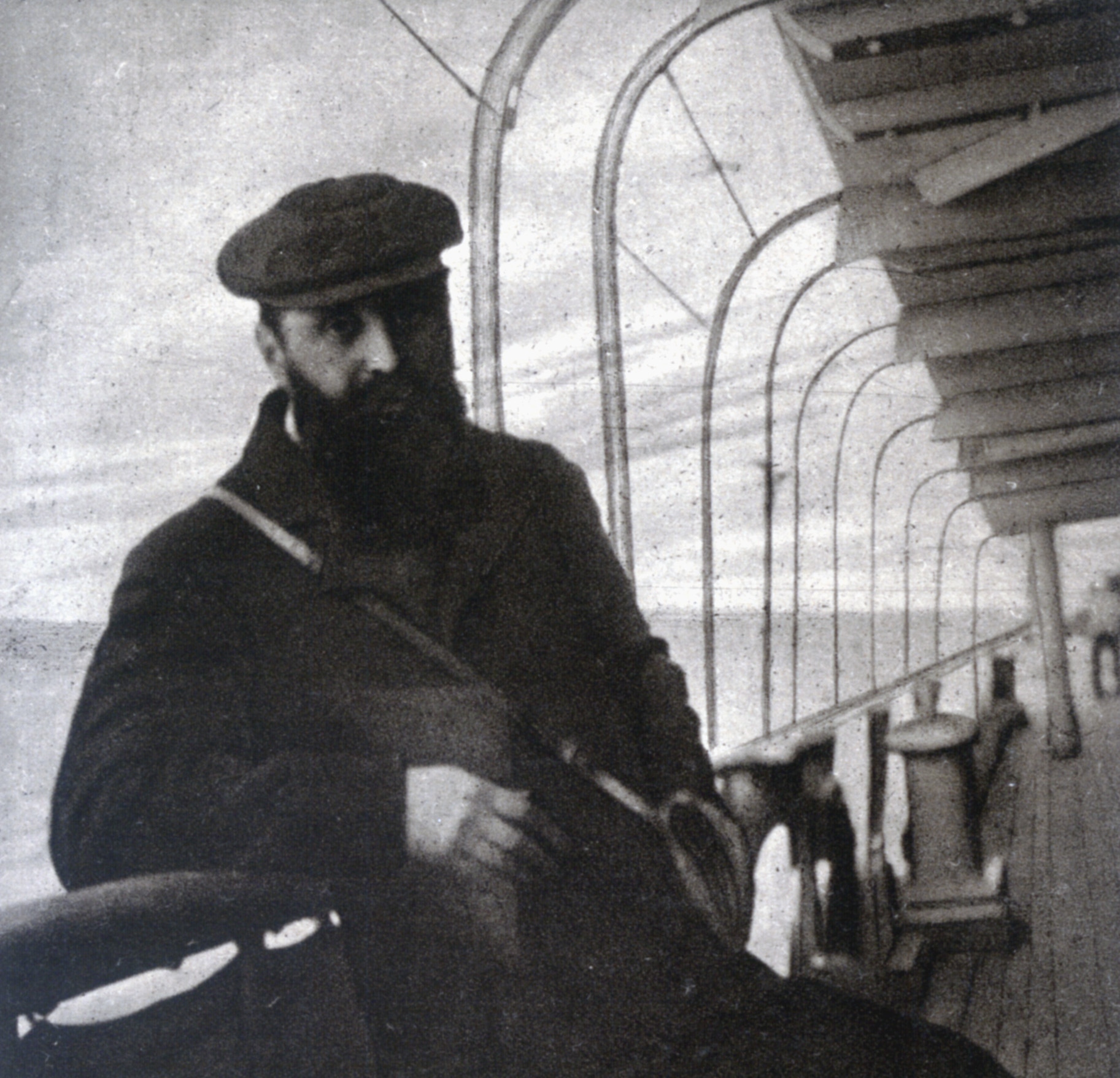
Theodor Herzl on a voyage to Egypt, 1903. Photo: Walter Anton / Wikimedia
Like most Jews of Central and Western Europe, who saw themselves as
modern and enlightened, Herzl despised the Jews of the East. In his
eyes, they were primitives stuck in medieval times, resistant to the
Enlightenment and decidedly un-European. He certainly did not think they
could carry the mantle of Zionism and build the state he envisioned.
The last thing he wanted for a Jewish state was to replicate the shtetl
life of Eastern Europe and Tsarist Russia. But even as Herzl was being
rebuffed by the cultured Jews of the West, he was, as Elon wrote,
“surprised by the resonance of his tract in the East; he had expected it
to strike hardest in the assimilated West, not in the East, which he
regarded as backward, even primitive.” But the Eastern European Jews
were the ones who embraced Zionism. They were inspired by his vision.
They wanted to be the builders of the new state. And they were willing
to do what it took to resurrect Jewish sovereignty in the blistering
heat of the Land of Israel.
Touring Europe with his vision, whether among the shtetl immigrants of London or the Jews of Bulgaria, Herzl was overwhelmed by the reception.
News of his passage had preceded him. When the train stopped at the
station an enormous crowd of Bulgarian Jews hailed the author of The Jewish State
as their long-awaited savior…. People rushed to kiss his hand, and in
the synagogue he was placed by the altar. He did not know how to face
the crown without turning his back to the holy Torah. But a man called
out: “It is all right for you to turn your back to the altar. You are
holier than the Torah….” With his magnificent beard, his glowing eyes,
his proud frame, and fine, simple gestures, Herzl stood on the stage,
looking “as kings wish to look but seldom do.”
He was received by the Jews of the East like the Messiah who would take them back to the land of their ancestors.
Overwhelmed by this reception, Herzl the writer realized that the
time had come for rewriting. He recast the Jews of Eastern Europe as the
true national Jews. He wrote them into his story as those who had kept
their sense of being a nation while the assimilated Jews of the West had
not. In Herzl’s rewritten narrative, the Jews of Eastern Europe became
better suited to the task of building a Jewish state than anyone else;
because they, above all others, knew what it meant to be a nation; and
Zionism was first and foremost about the national revival of the Jewish
people.
During the first Zionist Congress, Elon writes,
The Russian Jews had left the deepest impact [on Herzl]. Warm
hearted, soulful, eminently practical, deeply steeped in folk tradition,
which in the East was still very much alive, they had none of the
identity problems of the Western Jews, none of his sense of alienation.
Herzl had previously thought of them as poor, oppressed candidates for
relief, living in a “primitive” East; it took the congress to open his
eyes: “How ashamed we felt, we who had thought that we were superior to
them. Even more impressive was that they posses an inner integrity that
most European Jews have lost. They feel like national Jews but without
narrow and intolerant conceit…. I had often been told in the beginning,
‘The only Jews you’ll win will be the Russian Jews.’ Today I say, ‘They
would be enough!’”
Indeed, over the next three decades, the Jews of Eastern Europe
became the primary adherents of the Zionist vision and the ones who
built its foundations against overwhelming odds. By embracing them and
rewriting his narrative to reflect their enthusiasm for the cause, Herzl
demonstrated that, for Zionism to survive, it would need to include
everyone who supported it. He also showed how to achieve this: By
rewriting the story to include the previously excluded group; and to do
so in a way that not only included the new group, but made it one and
the same with the Zionist vision.
Inclusiveness has many forms, and different countries and ideologies
have found different ways of accomplishing it. France has a secular
republican model under which anyone can become French if they adopt the
values of the republic, live in a secular public sphere, keep competing
identities such as religion to the private sphere, and embrace French
culture and language. America has a post-national model that depends
heavily on embracing the principles of the constitution and the
“American way of life.” Britain has a post-colonial model under which
peoples and religions are united under the scepter of the queen. All
models of inclusion in countries that claim to be inclusive are
problematic. All of them are partial. All suffer from a gap between the
claim to inclusion and the reality. And all are challenged by groups who
do not accept the “rules for inclusion.” In that sense, Zionist
inclusiveness is no different. But its mechanism is.
The Zionist mechanism is one of retelling and rewriting its story as
if Zionism was always designed to include a previously excluded group.
This mechanism is not one of simple assimilation, “multiculturalism,” or
even the “melting pot.” It is a constant rewriting of the story of
Zionism so that a new story emerges to erase the old, thus creating the
sense that Zionism has always been able to include the previously
excluded group.
This is no different from the way all human beings adapt to changing
circumstances. We write and rewrite our histories. We take moments of
failure, despair, and rejection, and remake them into stories of growth,
transformation, and triumph. We create a unified narrative that makes
sense out of everything that has happened to us. We tell ourselves it
had to happen so we could become who we are today. Internally, almost
all humans—except for the clinically depressed—are like Pangloss, the
perennially optimistic philosopher in Voltaire’s Candide.
Theodor Herzl’s visit to Israel, 1898. Photo: Pikiwikisrael / Wikimedia
The Zionist mechanism works in the same manner. It is a constantly
retold story, but at any given moment it is also a unified one. It is
not a legalistic mechanism of “neutral” citizenship in a “neutral”
state, where abiding by the law is the only requirement and all who
abide by the law are equally included. The Zionist state believes in
equality before the law, but Zionist inclusiveness works in a very
different way: Zionist inclusiveness is about the story, not the law.
One of the most remarkable examples of Zionism’s ability to rewrite
its story and transform its narrative is its relationship to the
Holocaust. This narrative transformation has been achieved so completely
that almost everyone now believes the State of Israel was born as a
direct result of the Holocaust, and owes its existence to the tragedy
and its survivors. To understand the magnitude of this transformation,
we need to appreciate how difficult it was for Zionism to deal with the
Holocaust.
Zionism was first and foremost an ideology of activism. It was a
rebellion against Jewish passivity in exile, a rejection of the Jews’
resigned attitude toward their fate as a persecuted and marginalized
minority. As a secular movement, it rebelled against simply waiting for
the Messiah. It called for the Jewish people to be their own Messiah, to
go by themselves to the Holy Land to restore Jewish sovereignty, rather
than waiting for God’s anointed to do it for them.
In addition, Zionism contained an element that called for the total
negation of Jewish life in exile. This, however, was not true for all
Zionist thinkers. Herzl, for example, imagined that the re-establishment
of Jewish sovereignty would also contribute to the life of Jews in
exile by relieving them from the status of a stateless people at the
mercy of the nations. He described in his novel Altneuland (“Old-New
Land”) that with the establishment of the Jewish state, “Jews who
wished to assimilate with other peoples now felt free to do so openly,
without cowardice or deception. There were also some who wished to adopt
the majority religion, and these could now do so without being
suspected of snobbery or careerism, for it was no longer to one’s
advantage to abandon Judaism.”
Herzl thought that Jews would be able to walk proudly as equals among
the nations once they had a state, even if they did not become its
citizens. But as the situation in the Diaspora became more severe and
ultimately genocidal, the choice made by many Jews to remain in Europe
was scorned. For many Zionists, the growing strength of their embryonic
state and the growing danger faced by the Jews of Europe delegitimized
life in the Diaspora.
The negation of the exile (shlilat ha’galut in Hebrew), as
it became known, was not just about negating the legitimacy of Jewish
life in the Diaspora, but also negating its very essence. Zionism
created an entire series of opposites expressing this: Active vs.
passive, strong vs. weak, proud vs. humiliated, self-sufficient vs.
dependent, healthy vs. sick. Zionism came to be seen as a cure for the
sickness inflicted upon Judaism by the exile.
Zionism adapts by rewriting the story to include the
previously excluded group, doing so in a way that not only includes the
new group, but makes it one and the same with the Zionist vision.
So when the Holocaust occurred, it was an affront to Zionism’s core
ideology. The Jews who perished in the Holocaust represented everything
that Zionism wanted to change. The victims were seen as passive, going
to their deaths like “lambs to the slaughter.” They were weak,
dependent, and suffered the greatest possible humiliation—an industrial
genocide. Whenever they rebelled, it was because they were Zionists. The
Warsaw Ghetto resistance fighters, for example, became national heroes,
in part because they were members of Zionist youth movements preparing
to immigrate to Israel. The survivors were even worse in the Zionist
perception. They were suspect simply because they had survived. The
suspicion was that they must have engaged in deceitful and treacherous
actions in order to do so.
The nascent State of Israel took the Holocaust survivors in and
recruited them to fight for its independence. This was, again, a
pragmatic inclusiveness. Israel needed them to survive. But it did not
want to hear their story, and it found no place for them in the Zionist
narrative. At best, they served as Exhibit A of why there could be no
Jewish life in exile. They were the negative to Zionism’s positive.
Beginning with the public trial of Adolf Eichmann in 1961, however,
the people of Israel not only started to listen to the survivors, but to
rewrite the story of Israel and Zionism accordingly. It did not happen
quickly, but over the next few decades, the story of the Holocaust and
its survivors became so integrated into the story of Zionism that many
today believe the Holocaust is the reason for Israel’s existence. This
has become such a dominant story that many people around the
world—including Jews and Israelis—are barely aware of the history of
Zionism and the pre-state Zionist community that preceded the Holocaust.
The survivors of the Holocaust eventually became Israel’s new heroes.
Not just the Zionist resistance fighters, but any and all who survived.
Just this past Holocaust Remembrance Day, Twitter and Facebook were
taken over by photos of soldiers with Holocaust survivors, who were
hailed as Israel’s true heroes.
The retelling of Zionist history to incorporate the Holocaust and its
survivors is now complete. Zionism genuinely stripped itself of its
scornful attitude toward the survivors, and achieved complete
inclusiveness by transforming its narrative.
A new immigrant family moves into a ma’abara, a refugee absorption center, near Tel Aviv. Photo: Zoltan Kluger / flickr
Another major group is still in the process of undergoing narrative
inclusion: The Jews who immigrated to Israel from Arab countries. Prior
to the Holocaust, they were a tiny minority of the Jewish world. Only
one million out of a world total of 18 million Jews resided in North
Africa and the Arab Middle East. With colonialism ending and the
impending establishment of the State of Israel, tensions between the
Muslim Arab population and the Jews rose. Over the course of only a few
years, these Jewish communities—which in most cases predated Islam—were
removed. A large number of the Jews fleeing these countries found refuge
in the newly created State of Israel.
Much like survivors of the Holocaust, the Jews from Arab countries
were recruited into the Zionist state-building effort, but they were not
welcomed or included in any real sense. They were viewed as being “not
us”—“nicht unsere” to use the Yiddish term. For decades, they
suffered overt and covert discrimination. But they slowly found
themselves, mostly through their own struggle and effort, becoming part
of Israeli society, to the point that they all but became
Israeli society. To a great degree, this inclusion was achieved through
marriage. When I speak to large groups of Israeli students or soldiers I
like to conduct a little exercise. I ask how many among them have four
grandparents of the same ethnic origin. Usually, in a room of 200, less
than ten hands will be raised.
Many will no doubt claim that, with all due respect to the
achievements of Zionism, it has never sought or succeeded in including
non-Jews. It is one thing to include all the Jews in the world—an
impressive feat in itself—but quite another to include non-Jews.
First, it is important to note that Herzl’s own conception of Judaism
was so secular and national that he felt religious Muslims, Christians,
and Jews could all be Zionists. He thought the Jewish state should be
akin to the French state, allowing people to have different religious
faiths or none at all. So, at least as conceived by Herzl, Zionism was
not meant for the Jews alone, and non-Jews could partake in it.
Throughout Altneuland, Herzl emphasized, “The fundamental
principles of humanitarianism are generally accepted among us. As far as
religion goes, you will find Christian, Mohammedan, Buddhist, and
Brahmin houses of worship near our own synagogues.” In his vision of a
future Jewish state, “Religion had been excluded from public affairs
once and for all. The New Society did not care whether a man sought the
eternal verities in a temple, a church, or a mosque, in an art museum or
at a philharmonic concert.” Herzl’s ideal as stated in Altneuland
is “We do not ask to what race or religion a man belongs. If he is a
man, that is enough for us.” In the novel, in fact, it is exclusionary
Jews who are portrayed as the main enemy.
Many Soviet immigrants to Israel are an example of Herzl’s idea in
action. Though they could claim citizenship due to their Jewish
ancestry, many were not Jews themselves, and some were practicing
Christians. Yet their immigration to Israel was considered highly
valuable—even one that “saved” the country. In fact, when their status
as non-Jews did became an issue—such as burial of fallen soldiers—it was
met with anger from the broader Israeli society; indicating that, for
most Israelis, they belonged fully and unquestionably.
The
Herev (sword) Battalion, composed completely of Druze citizens who
choose to enlist in the unit, conducts a training exercise. Photo:
Matanya / Wikimedia
Over recent decades, Israel has also sought to include its Druze and
Bedouin communities. The initial reason was, again, pragmatic. In this
case, the need for soldiers. As early as Israel’s War of Independence,
many Bedouin and the entire Druze community joined the Jews in fighting
off the invading Arab armies. From that moment, the Druze and many
Bedouin were included in the Israel Defense Forces. Since then, Druze
and Bedouin military heroes have been hailed by Israeli society and
media. Indeed, during the latest conflict with Hamas, a Druze senior
commander became a media hero after he demanded to be sent back into the
field despite severe injuries. Many Druze self-identify as not merely
Israelis, but also Zionists. This is not to say that there are no
problems with discrimination or other issues, but it does show that
Zionism is willing to embrace those who align themselves with it,
whether Jewish or non-Jewish. Indeed, it seems that Zionism only finds
it difficult to include non-Jews when they embrace competing Arab or
Palestinian national identities. Zionism in itself can include non-Jews
in its story, so long as they do not align themselves with a hostile
narrative.
The current frontier of inclusion is that of ultra-Orthodox Jews and Israeli Christians.
In the past, Israeli Christians by and large adopted Arab and
Palestinian identities. Christians were among the most important
thinkers and shapers of modern Arab and Palestinian nationalism, and
often its most zealous adherents. This is due, in part, to their status
as a minority among Arab Muslims. In recent years, however, as the Arab
Spring revolutions have placed the lives of Middle Eastern Christians in
jeopardy, Israeli Christians have begun to explore the possibility of
an Israeli rather than Arab Christian identity. As Arab identity is
increasingly perceived as exclusively Muslim and even openly hostile to
Christians, Israeli identity has emerged as a new possibility for
identification. Like the Druze and Bedouin, this is being explored
through service in the IDF, as more and more voices in the Christian
community look to military service as a means of engaging with “their
state.” In response, the IDF is taking steps to make military service
more accessible. This process has only just begun and is politically
controversial, but it demonstrates again that Zionism is willing and
capable of integrating non-Jews who do not embrace a competing identity
hostile to Zionism.
Ultra-Orthodox Jews, for their part, have had an ambivalent
relationship with Zionism from the beginning. Zionism was a thoroughly
modern movement that believed human beings should shape their own fate,
rather than passively accept the will of God. In addition, it was
composed of mostly secular and even atheist Jews who rebelled against
the religious way of life. As a result, many ultra-Orthodox thinkers saw
Zionism as heresy. Some extreme ultra-Orthodox sects even claimed that
Zionism was an affront to God and an obstacle to the realization of
God’s plans for the Jewish people, so only by destroying the State of
Israel can the arc of history be put right again.
Father
Gabriel Naddaf of Nazareth, an Arab-Israeli Greek Orthodox priest, has
issued a call to Arab Christians to serve in the IDF and integrate into
Israeli society. Photo: ShalomYerushalayim1 / YouTube
Yet the Holocaust left the surviving ultra-Orthodox Jews in need of
refuge, and many found it in the State of Israel. Nonetheless, even
ultra-Orthodox Israelis have found it difficult to come to terms with
the existence of a secular Jewish state, and especially with its
success. Moreover, unlike Zionists who believed that sovereignty was
essential to Jewish survival and prosperity, the ultra-Orthodox felt
that the exile posed no threat to the future of the Jewish people, and
might even be preferable.
For most of Israel’s existence, the Zionist majority was willing to
let the ultra-Orthodox maintain their way of life and remain on the
margins of Israeli society. But in recent years, as the ultra-Orthodox
community has become much larger, more and more Israelis feel that the
status quo cannot be sustained. In particular, they believe
ultra-Orthodox Jews’ heavy dependence on the welfare state, low
participation in the labor force, and almost non-existent military
service places an unfair burden on other Israelis.
So began the battle to include ultra-Orthodoxy in the Zionist
narrative. Initially, it took the form of a demand for military service
and greater participation in the labor force. In other words, the
motivation was once again pragmatic. Zionism wants the ultra-Orthodox to
be taxpayers and soldiers. But over time, it is likely that the
mechanism of narrative transformation will begin to operate. The Zionist
story will be rewritten so as to make ultra-Orthodoxy into another,
equally genuine form of Zionism. The 2,000-year-long continuing
existence of ultra-Orthodox communities in the holy cities of Jerusalem,
Hebron, Safed, and Tiberias, for example, may be portrayed as having
paved the way for modern Zionism and secured the path for the return of
the Jewish people to their homeland.
The last frontier of inclusion is unquestionably that of Israel’s
Muslims, who currently describe themselves as Arab Palestinian Muslims
holding Israeli citizenship, and it is the most difficult. At the
moment, it seems almost ludicrous to think about their future inclusion
in the Zionist narrative. Israeli Muslims themselves are likely to see
the idea as an affront to them and their sense of Arab-Palestinian
national identity. But I would like to present the possibility that,
sometime in the future, such inclusion could take place.
Currently, the Palestinian national movement and Zionism appear so at
odds that it is nearly impossible to conceive of a situation in which
the Zionist narrative could be sufficiently rewritten to include Israeli
Muslims. The furthest that most Israeli Muslims are willing to go in
this direction is to demand a “neutral” Israeli state, stripped of any
signs or symbols of being Jewish or Zionist. The argument put forth by
them and especially their leadership is that as long as the state of
Israel continues to be Jewish or Zionist, Muslims can have legal rights,
but will never truly be a part of Israeli society.
As a result, for many Israeli Muslims, the only path to full
inclusion and belonging is an end to Zionism. In the current situation,
this is somewhat understandable. If Zionism and Palestinian nationalism
are in direct conflict, the embrace of one naturally implies the
rejection of the other. But it is also, of course, impossible for
Zionism to accept, since it demands not the rewriting of the Zionist
story, but the burning of the book itself.
As a result, the inclusion of Israeli Muslims in the Zionist
narrative is likely to happen under one of two extreme conditions: Full
peace between Israel and the Arab world, or an Arab world so engulfed in
chaos and brutality that Israeli Muslims distance themselves from an
Arab Palestinian national identity in search of an alternative. Under
one of these extreme but not impossible scenarios, Israeli Muslims would
no longer be Arab Palestinian nationalists, but Israelis and Zionists.
The next frontier of Zionist inclusion is adapting the story to fit Christians, ultra-Orthodox Jews, and possibly Muslims.
Should either of these scenarios materialize, the obstacles to
inclusion would be lifted, at least in principle. One could begin to
imagine the Zionist narrative being retold so that Israeli Muslims are
fully included in the story. This inclusive narrative could be about how
Muslims tended and kept the land for centuries, welcoming the returning
Jews to share it for the good of all. It could be the story of how
local traditions of generous hospitality led the local Muslims to
provide refuge to the Jews coming to their shores. It could be a story
with new heroes—Jews and Muslims who exemplified cooperation long before
it was the norm; Muslims who protected Jews from harm; Muslims who sold
land to the Jews and shared valuable agricultural knowledge with them;
and Muslim teachers who taught about Zionism without neglecting their
own side of the story.
It could be a narrative that resurrects the buried history of
Muslim support for Zionism in Palestine. This history was recently
uncovered in Hillel Cohen’s book Army of Shadows: Palestinian Collaboration with Zionism,
which covers the many dissident elements in the Palestine Arab Muslim
community that viewed Zionism positively—as Herzl had hoped—and even
assisted it through land sales, intelligence, and military assistance
against the British. It could be a story that reminds us of heroes like
Haifa mayor Hassan Bey Shukri, who wrote to the British government in
1921,
We strongly protest against the attitude of the said delegation
concerning the Zionist question. We do not consider the Jewish people as
an enemy whose wish is to crush us. On the contrary, we consider the
Jews as a brotherly people sharing our joys and troubles and helping us
in the construction of our common country.
It could perhaps become the story of how the Muslims, together with
Jews, made the land of Israel whole again, bringing together all the
religions that originated and flourished within its borders. It could be
a story of return and reunification. A story of how the Muslims had to
come to terms with being a minority and the Jews with being a majority
before both could truly live as one, introducing the key element in any
drama of return and reunification: The overcoming of obstacles.
It must be left to far better storytellers than myself to imagine
what this narrative might look like. Right now, it requires the most
fanciful imagination. But if Zionism has taught us anything, it is that
reality begins with a dream.
NatanFlayer / Wikimedia
Other Articles: